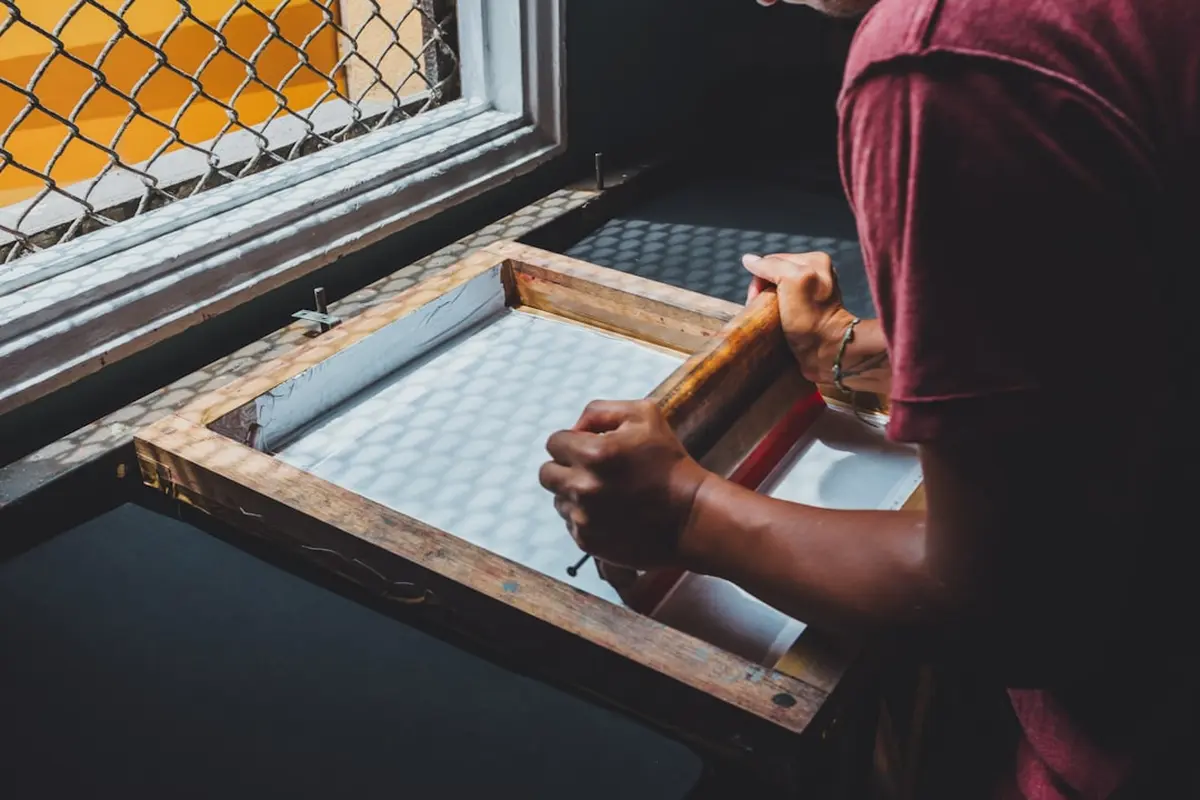
The water-soluble set is the correct refill for almost every reader whose starter-kit tube of black has run dry, and the oil-based set is correct only for someone who wants a print rich enough to frame or dry enough to take a watercolour wash later. What separates them is not quality. It is time, and time governs the whole session.
Here is the figure that frames it. Speedball's own store lists the Water-Soluble Block Printing Ink 6-Color Set at $34.57 including tax, six tubes of 1.25 fl oz (37 ml), which is about $5.76 a tube or roughly 16 cents per millilitre. A 75 ml tube of artist-grade Cranfield Caligo Safe Wash black is listed by Jackson's Art at $14.31, or about 19 cents per millilitre. The student-to-artist price gap in relief ink, per unit of ink, is about 20 per cent. The gap in what happens on the block is considerably larger.
One caveat before the table. Speedball publishes no opacity or lightfastness sheet for either starter set, so every claim below about working time, patchiness and richness comes from printmakers who used the inks and wrote it down, named in each row.
The figures, side by side
| Specification | Speedball 3470 Water-Soluble Set | Speedball 3476 Oil-Based Set | Cranfield Caligo Safe Wash Relief |
|---|---|---|---|
| Ink base | Water-soluble | Oil-based | Oil-based, pigment dispersed in copper plate stand oil and linseed oil (iMcClains) |
| Tube size | 1.25 fl oz (37 ml) | 1.25 fl oz (37 ml) | 75 ml tube, plus 250 g and 500 g tins |
| Published per-tube price | $5 to $12, water-based band (Hobby Shop Online, April 2026) | $7 to $15, oil-based band (Hobby Shop Online, April 2026) | $16 to $26 (The Friendly Printmaker) |
| Cleanup | Soap and water, no solvents (Speedball) | Soap and water, no solvents (The Friendly Printmaker) | Dish soap worked into the ink, then rinsed (Tamara Jaeger) |
| Working time on the block | Can clump or lose water miscibility in about 15 minutes on thin layers (WetCanvas, Tamara Jaeger) | Oil-based inks hold sessions of hours (The Weekend Beckons) | Sessions of hours, rolls out smoothly on the brayer (The Weekend Beckons, Tamara Jaeger) |
| Drying of the finished print | Fast enough for a finished piece the same day (The Weekend Beckons) | Days to weeks, as with oil-based inks generally (The Weekend Beckons) | Days to weeks, and one user reported rub-off a year after printing (WetCanvas) |
| Watercolour washed over the print | Moisture on the print side can dissolve the ink film (WetCanvas) | Layering with watercolour possible once fully dry (The Weekend Beckons) | Layering with watercolour possible once fully dry (The Weekend Beckons) |
| Published permanence data | Lightfastness stated on the packaging, pigments not named (The Weekend Beckons) | AP Certified for professional, permanent prints (Speedball) | Blue Wool 6 minimum across the range, black rated 8 (Artist Pigments) |
| Non-toxicity seal | AP non-toxic (Dog Notebook) | AP Certified (Speedball) | ACMI AP Approved Product (The Friendly Printmaker) |
| Made in | USA (Speedball) | Statesville, North Carolina, Speedball's oil-based line (The Friendly Printmaker) | Great Britain, handcrafted (The Friendly Printmaker) |
Speedball 3470 Water-Soluble Block Printing Ink Starter Set
Speedball calls its water-soluble line "the unquestionable industry leader" and promises ink that prints "in bold color and dry to a rich, satiny finish" with "excellent tack, ensuring even coverage". The set is six 37 ml tubes at $34.57 direct from the maker, vegan, made in the USA, with a two-year shelf life and cleanup that needs nothing but soap and water.
Printmakers who have used it alongside better ink describe something more specific. The author of a side-by-side ink comparison at The Weekend Beckons found the Speedball water-based ink "leaves a strange pale line near the edge of many print areas" and now keeps it for test prints rather than finished pieces. On the WetCanvas ink comparison thread, users report that water-miscible inks "lose the water miscibility very fast when the ink starts to dry. Sometimes even 15 minutes is enough for thin layers", that fine detail is captured less reliably after the first print or two unless the block is fully re-cleaned, and that the paper has to be on the dry side, because moisture on the print side can dissolve the film.
That last point answers the watercolour question directly. Ink that dissolves in water at the sink dissolves in water on the page.
For a reader printing cards, gift tags or a small paper edition at the kitchen table on a Saturday, with everything dry and cleared away by Saturday night, this is the set to buy.
- $34.57 for six 37 ml tubes direct from Speedball, about $5.76 a tube
- Soap and water cleanup, no solvents
- Dries fast enough to finish a piece the same day (The Weekend Beckons)
- Two-year shelf life, so a six-colour set is not a race against time
- Budget-friendly and stocked in craft and art stores (The Weekend Beckons)
- Working window of roughly 15 minutes on thin layers before the ink starts drying on the block (WetCanvas)
- Patchiness and a pale line near the edge of print areas reported (The Weekend Beckons)
- Fine detail degrades after the first prints unless the block is re-cleaned (WetCanvas)
- Re-wets, so a watercolour wash over the print risks lifting it (WetCanvas)
- Lightfastness is stated on the packaging but the pigments are not named (The Weekend Beckons)
Speedball 3476 Oil-Based Block Printing Ink Starter Set
Speedball's oil-based block printing ink is a separate line sold in the same 1.25 fl oz tube format, AP Certified for professional, permanent prints. Cleanup is soap and water, not solvents: The Friendly Printmaker, writing on Speedball's oil-based paper and fabric ink, notes that "this oil-based ink only requires soap and water cleanup", and Jackson's Art describes Speedball Professional Relief Ink, the archival oil-based sibling, as washing up the same way.
What that buys is the oil-based working profile rather than the Speedball name: hours of open time instead of fifteen minutes, more even coverage, and a print that will accept a watercolour wash once it has fully dried. What it costs is the wait. Oil-based relief prints take days to weeks to dry, which makes a two-colour reduction print a project measured in weekends.
One honest gap: none of the sources consulted publish a set price for the 3476, nor an opacity or lightfastness specification from Speedball for it. The general market band for oil-based tubes was $7 to $15 as of an April 2026 beginner guide from Hobby Shop Online, which puts it in the same neighbourhood as the water-soluble set rather than in Caligo territory.
This is the set for a reader who already knows they want oil behaviour, prints on paper they care about, and is content to leave prints on a shelf for a week.
Cranfield Caligo Safe Wash Relief Ink
Caligo is a genuine oil-based ink that washes with dish soap and water, a formulation Cranfield developed well enough to win the Welsh Small Environmental Company of the Year award in 1999. McClain's describes the ink as "lightfast and highly pigmented", ground on water-cooled triple roll mills and batch-tested for "strength, color, tack, drying time, printability, viscosity, fineness of grind and lightfast rating". The independent Artist Pigments database records a Blue Wool rating of at least 6 for every colour at full strength, with 30 per cent of the range at 8 and black itself rated 8. Twelve shades are single-pigment.
That is the one figure in this piece nobody else supplies. Speedball publishes no equivalent.
In use, Tamara Jaeger's review reports a "nice, rich black print", smooth rolling, and a long enough working time to avoid the pale patchy areas she associates with water-based ink. She also reports that Caligo bleeds through thin printmaking paper more readily, fixed by slipping tracing paper behind the sheet while burnishing, and that cleanup, though solvent-free, takes repeated washes and risks warping unmounted lino if water gets away from you. A WetCanvas member reported ink "still rubbing off on a rag" a year after printing.
Pricing at Jackson's Art: $14.31 for 75 ml black, $45.23 for the 500 g black tin, $77.60 for the 75 ml Set of 6 Soft Shades, and £55.00 for the standard Set of 6 on the UK site. The Friendly Printmaker puts individual tubes at $16 to $26 and a six-colour set at $70. Buy it when a print is going in a frame or an envelope with a price on it.
- Blue Wool 6 minimum across the range, black at 8 (Artist Pigments)
- Twelve single-pigment shades for predictable mixing (Artist Pigments)
- Soap-and-water cleanup with no solvents or ventilation rig (Tamara Jaeger)
- Long open time and a rich, even black (Tamara Jaeger, The Weekend Beckons)
- 75 ml black at $14.31 at Jackson's Art works out near the per-millilitre cost of the Speedball set
- Six-colour sets run $70 to $77.60, roughly double a Speedball starter set
- Bleeds through thin printmaking paper more than water-based ink (Tamara Jaeger)
- Cleanup takes repeated washes and water can warp unmounted lino (Tamara Jaeger)
- Days to weeks to dry, and one report of rub-off a year on (WetCanvas)
- No metallics in the Safe Wash line (Tamara Jaeger)
Drying is the whole argument
Three things separate these inks, and two of them are clocks.
The first is the clock on the block. Fifteen minutes before thin layers start to set, against sessions measured in hours. That single number explains the pale edges and patchiness reported of the water-soluble ink, and it explains why water-based printers re-clean the block every few pulls while oil printers do not. A reader carving a detailed block and hoping for twelve consistent pulls is fighting the ink, not their carving.
The second is the clock on the print. Water-soluble is dry the same day; oil is dry in days to weeks. This is not a defect of oil, it is the trade being made. It does, however, decide the watercolour question outright. Oil ink accepts a wash once fully dry, which is why prints hand-coloured with watercolour are almost always oil-printed. Water-soluble ink and a wet brush are the same chemistry as water-soluble ink and a kitchen sponge.
The third is what "oil-based" no longer means. Beginner guides still say it means solvents: Hobby Shop Online's April 2026 guide says oil-based ink "requires mineral spirits for cleanup", and Dog Notebook's September 2026 kit roundup repeats that it "requires solvents for cleanup". Neither applies to the three products here. Speedball's oil-based ink, Speedball Professional Relief Ink and Caligo Safe Wash all wash with soap and water. Anyone avoiding oil ink because of a ventilation worry is avoiding a product that stopped existing at this price tier some time ago.
The strongest objection to recommending the cheap set is that nobody who has used both prefers it. The Weekend Beckons demoted Speedball water-based to test prints. WetCanvas sentiment ran toward traditional solvent oil inks for working time, detail and reliability. Jackson's Art tells outright beginners to start on Caligo. All of that is true, and none of it changes the answer, because the constraint on a hobbyist printing six evenings a year is not whether the black holds its value to Blue Wool 8 in 2060. It is whether the print is dry before the table is wanted for dinner.
A Saturday that settles it
One block, two inks, and a verdict arrived at without reading another comparison.
-
Carve one small block and pull six prints in water-soluble black
Work in short bursts. With roughly fifteen minutes before thin layers start setting, re-ink and re-clean the block rather than pushing through a long session.
-
Pull a seventh print on better paper with oil-based black
If using Caligo, slide a sheet of tracing paper behind the printing paper while burnishing, which is Tamara Jaeger's fix for its heavier bleed-through on thin stock.
-
Wash both blocks in the sink
Water-soluble rinses off. For the oil ink, work dish soap into the inked areas first, then add water, and keep standing water off an unmounted lino block, which warps.
-
Date the oil print and put it somewhere flat
Days to weeks, not hours. Label it, because the whole point of the test is knowing when it is genuinely dry.
-
Next weekend, brush a watercolour wash across a corner of each
The water-soluble print will move under the brush. The oil print should take the wash cleanly once fully dry. That difference is the entire purchase decision, in one afternoon.
Verdict
Buy the Speedball 3470 six-colour water-soluble set at $34.57 from Speedball. It is the right ink for a beginner who prints on paper, wants six colours instead of one, and wants the kitchen back the same evening. The reported pale edges and short working window are real, and at under six dollars a tube they are the correct problems to have while learning to carve.
Buy the 3476 oil-based set instead if the plan is layered or hand-coloured prints. It brings the oil working profile and AP certification for permanent prints at roughly Speedball money, and it cleans up in the sink.
Skip both and buy Caligo only if the prints are going into frames or an Etsy listing, where Blue Wool 6 minimum and a black rated 8 are worth the $70 to $77.60 a six-colour set costs.
The more useful move for most readers is not a set at all. Relief printing consumes black faster than every other colour combined, and a 75 ml tube of Caligo black at $14.31 from Jackson's Art holds twice the ink of a Speedball tube at about 19 cents a millilitre against the water-soluble set's 16. Buy the cheap six-colour set for practice and colour, buy one artist-grade black for the prints worth keeping, and stop treating the choice as a side to pick.
Comments
No comments yet. Be the first to comment!
Leave a Comment