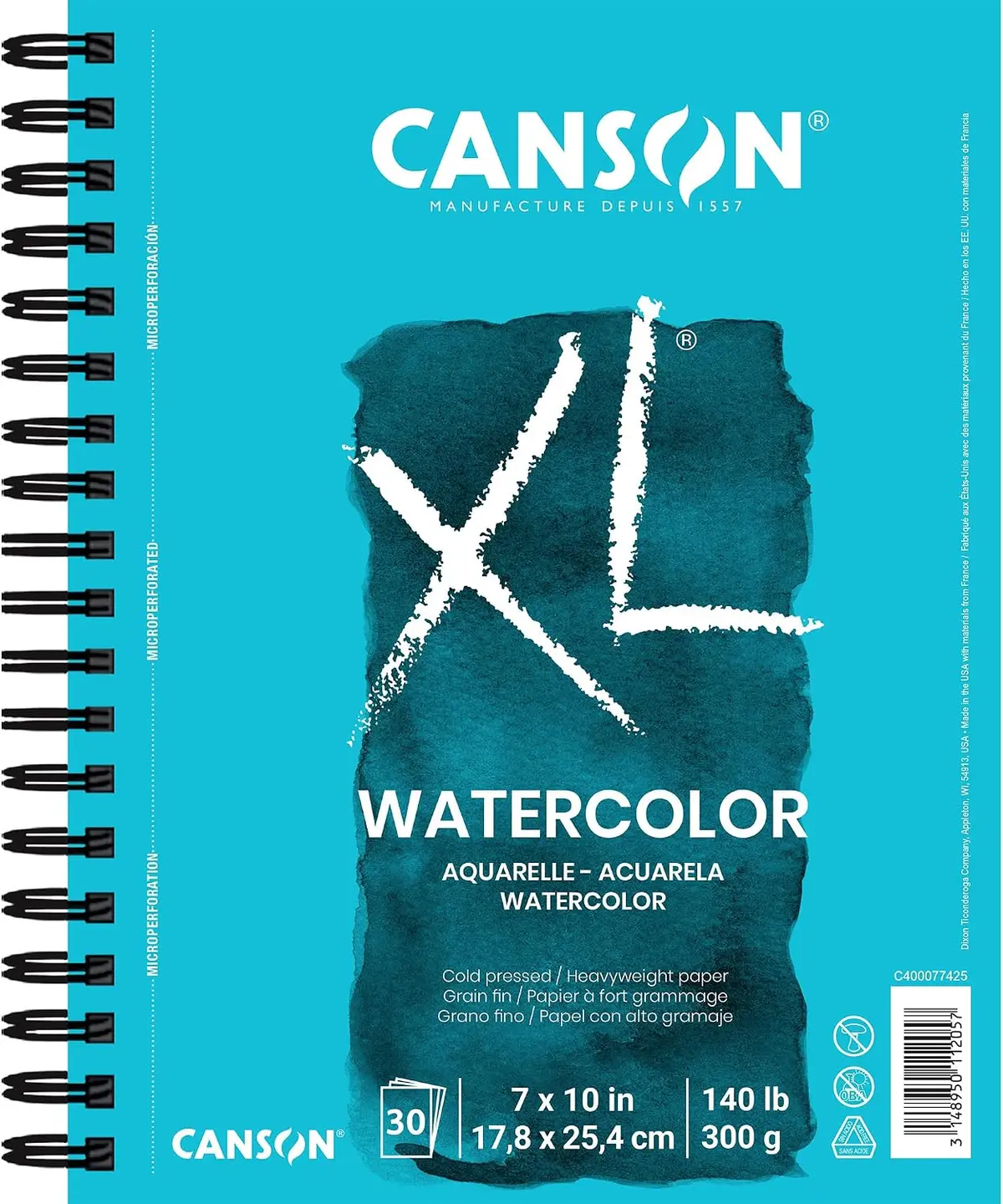
The best watercolor paper for a beginner is a 140 lb (300 gsm) cold press pad cheap enough to waste, bought alongside a few sheets of cotton that show what the cheap pad cannot do. The arithmetic behind that advice is blunt. A 30-sheet pad of Canson XL was listed at roughly $14 in a 2026 guide from Austin Gallery, about $0.47 a sheet, while 100% cotton paper runs $1.25 to $3 or more a sheet according to a beginner's roundup at bestwatercolorpaper.com. A hobbyist who paints most evenings will go through far more paper than paintings worth keeping, so the useful question is not which paper is best but how much of each kind to buy.
This page is for the self-taught or returning painter choosing a first real watercolor paper with their own money. The common mistake is to treat the decision as one of brand or weight. Almost every serious beginner paper is already 140 lb, so weight rarely separates the candidates. The real divide is fiber: cellulose (wood pulp) for volume, cotton for work that has to survive layering, scrubbing and the years. Most of the frustration beginners blame on cheap paper, chiefly buckling, turns out to be a handling problem that a roll of low-tack tape largely solves.

Arches Watercolor Pad 9 x 12 inches Natural White 100% Cotton Paper …

Strathmore 400 Series Wire Bound Watercolor Pad, 140 lb. Cold Press, 9 …


Fabriano Artistico 140 lb. Cold Press 20 Sheet Block 9x12" - Traditional …
What the paper is doing under the paint
Four properties decide how a sheet behaves, and a buyer meets them in roughly this order.
Surface. Cold press paper has a lightly textured surface that grabs pigment and absorbs water quickly, which reduces accidental puddles. Hot press is pressed smooth, suits crisp lines and botanical detail, and demands tighter water control. Homegrown Eclectic's beginner guide calls cold press the more forgiving of the two, and every source on this list agrees.
Weight. Watercolor paper is labeled in pounds per ream or grams per square meter, and the two systems describe the same sheets: 140 lb is 300 gsm. The Paul Rubens Shop guide (updated July 22, 2026) gives the clearest risk scale: 90 gsm (40 lb) "buckles instantly", 190 gsm (90 lb) carries moderate risk and needs stretching for heavy washes, 300 gsm (140 lb) stays flat even with heavy washes, especially in a block, and 638 gsm (300 lb) has near-zero risk. Weight buys stiffness, not quality, a distinction the lb and gsm labeling tends to blur for new buyers.
Format. Pads are bound on one edge; blocks are glued on all four, so the sheet is held flat while it dries. Paul Rubens Shop rates format as nearly as important as weight, with blocks showing "almost no warping" against loose sheets of the same weight.
Fiber. Cellulose paper is made from wood pulp and is cheap. Cotton paper holds water evenly, tolerates lifting and scrubbing, and keeps colors bright through repeated glazes. Austin Gallery's 2026 guide calls the switch from cellulose to cotton the single most impactful material upgrade a watercolorist can make, and notes that cellulose papers show visible yellowing within 5 to 10 years.
The four papers below cover the beginner's realistic range. Prices are as the sources published them, on the dates they carry; Artist Quirk has not rechecked them at retail, and the spread between sources for the same pad is itself a reminder that these numbers move.
| Canson XL Watercolor | Strathmore 400 Series | Fabriano Artistico | Arches Cold Press | |
|---|---|---|---|---|
| Role | Pure practice | Step-up value | First cotton, value route | First cotton, the benchmark |
| Fiber (bestwatercolorpaper.com; Austin Gallery 2026) | Cellulose; one source credits it with a partial cotton blend | Cellulose (wood pulp) | 100% cotton | 100% cotton |
| Weight | 140 lb / 300 gsm | 140 lb / 300 gsm | 140 lb / 300 gsm | 140 lb / 300 gsm |
| Price as published | About $14 (Austin Gallery, 2026); about $10 (CraftedBlog, undated) | $8 to $15 (bestwatercolorpaper.com, undated) | $20 to $35 (bestwatercolorpaper.com); about $41.37 per 9x12 block (Austin Gallery, 2026) | $25 to $43 (bestwatercolorpaper.com); about $45.91 per 9x12 block (Austin Gallery, 2026) |
| Flatness when wet (bestwatercolorpaper.com tests, Nov 2025; Art Ltd, Mar 2026) | Buckling noticeable even with light washes unless taped | Moderate buckling | No buckling result in the sources | Stayed flat through multiple wet applications |
| Main weakness | Surface can lift with tape; not a finished-work paper | Pills under aggressive scrubbing; duller color than cotton | Price | Price, and only 12 sheets per pad |
| Main strength | 4.8 stars from 31,000+ ratings (Progressive Radio Network, Oct 2026) | "One step up" from Canson XL (Homegrown Eclectic) | Superior whiteness; synthetic vegan sizing; rated 9.3/10 | Rated 9.5/10; color stays bright through 6+ glazes |
The fiber row hides a small disagreement. The bestwatercolorpaper.com beginner ranking says Canson XL's cotton blend gives it a slight edge over pure wood-pulp rivals; Austin Gallery and Progressive Radio Network both list it as cellulose. Neither claim comes with a fiber percentage, so the safe reading is that Canson XL behaves like a good cellulose paper, and should be bought as one.
Buying it, then painting on it by Sunday
The decision falls in four steps, and the first three are nearly settled before the shopping starts. The fourth, fiber, is where the money goes. The weekend project that follows turns the purchase into evidence: one afternoon on both papers shows a beginner more about the cellulose and cotton trade-off than any rating can.
The purchase and the first-wash test
-
Choose cold press
Unless the plan is botanical detail or crisp line work, cold press is the default. Every beginner source on this list recommends it over hot press for its forgiving texture. It worked if the label reads "cold press" or "CP"; some makers call it "NOT".
-
Choose 140 lb (300 gsm)
This is the standard that bestwatercolorpaper.com calls the industry norm and that Art Ltd Magazine treats as the minimum to "take a beating". Skip anything sold as 90 lb for painting; Progressive Radio Network classes it as sketchbook weight. Skip 300 lb for now; Homegrown Eclectic calls it unnecessary for those starting out. It worked if both pads in the basket say 140 lb or 300 gsm.
-
Choose a pad for practice, a block if one can be afforded for cotton
A pad is the cheap way to buy volume. A block holds the sheet flat on all four edges, which Paul Rubens Shop credits with almost no warping. For the cotton purchase, a 9x12 block is the format most priced in the sources. It worked if the practice paper comes in a pad of 30 or so sheets and the cotton paper is either a small block or a 12-sheet pad.
-
Buy cellulose for volume, cotton for comparison
The recommended pairing: Canson XL as the practice pad, or Strathmore 400 for a slightly better surface, plus one cotton paper. For the cotton, Fabriano Artistico costs 15% to 20% less than Arches per bestwatercolorpaper.com and scored 9.3/10 against Arches's 9.5. A buyer who wants the cheapest real cotton can look at Fluid 100, listed at $12 to $22 as the lowest-priced genuine cotton option in the same roundup. It worked if the total sits somewhere between about $25 and $60, depending on the cotton chosen.
-
Tape a Canson XL sheet to a board
Use low-tack tape along all four edges before the first wash, as the Progressive Radio Network guide (October 2026) advises. CraftedBlog warns that Canson XL's surface is tape-sensitive, so press gently and peel slowly later. It worked if no edge lifts when a finger runs along it.
-
Pre-wet both sides, then lay a flat wash
Sarah van den Berg of bestwatercolorpaper.com found that pre-wetting both sides and taping the sheet helped "enormously" with Canson XL's buckling in her November 2025 tests. Lay one even wash of a single color across the whole sheet. It worked if the sheet dries with gentle ripples at worst rather than hills that pool paint.
-
Repeat on the cotton sheet
Same color, same brush, same amount of water. It worked if the difference is visible: the sources predict a flatter sheet and a more even wash on cotton, since bestwatercolorpaper.com found Arches held flat through multiple wet applications.
-
Glaze and scrub both
Once dry, lay several glazes over a corner of each sheet, then scrub a small patch with a damp brush. bestwatercolorpaper.com reports Arches keeps colors bright through 6+ glazes, and Progressive Radio Network notes that pilling under scrubbing is among the top forum complaints about student paper. It worked if the cellulose corner goes muddy or fuzzy before the cotton one does. That is the lesson the project exists to teach.
The test spends two sheets of each paper and leaves the rest of the cellulose pad for the practice it was bought for. After one afternoon, the beginner knows from their own sheets when a painting deserves cotton, which is the judgment no buying guide can make for them.
Strathmore 400 Series Watercolor Pad 140lb Cold Press
Arches Watercolor Pad 140lb Cold Press 100% Cotton
Where it goes wrong
The complaints the sources report are few and specific. Progressive Radio Network summarizes recurring threads on r/watercolor101 and r/Watercolor as "buckling, sheet tearing, and a surface that pills when you scrub it", and notes that overall quality is not the main complaint.
Buckling. It is easy to recognize: the dried sheet rises into ridges, and paint collects in the valleys. Progressive Radio Network lists four causes: a paper core that is unsized or lightly sized and lets water through, a sheet too light for the water applied, a sheet left untaped, and humid storage. The fixes map onto the causes: 140 lb or heavier, tape on all four edges, and pads kept closed and flat. For lighter paper, the older remedy is to soak it, tape it down wet and let it dry flat, which is how to stretch lighter paper at home.
A sheet that has already buckled. Dry it between absorbent paper under heavy books for 24 hours, per Progressive Radio Network. The same guide warns that thin cellulose sheets may keep their creases anyway, so the remedy is for salvage, not something to plan around.
Torn or lifted surface when the tape comes off. CraftedBlog flags Canson XL as needing care with tape. The sign is a fuzzy strip where the tape was. Low-tack tape and a slow peel at a low angle are the answer, as is accepting that the practice pad is for practice.
Pilling under scrubbing. The surface balls into small fibers when lifting color. bestwatercolorpaper.com reports this specifically for Strathmore 400 under aggressive scrubbing. A beginner who relies on lifting has found the moment to move to cotton.
Mud in wet-on-wet and heavy layering. Art Ltd Magazine's March 2026 roundup found a Canson paper (listed as model 100510941) struggled with heavy layering and wet-on-wet because of its fine grain. Colors that go dull and blotchy on the third pass are the symptom. This is a limit of the paper, not of the painter, and is worth knowing before a beginner decides they cannot glaze.
Expecting student paper to behave like cotton. Art Ltd treats buckling on its student pick, the UCreate P4943, as an expected trade-off of student-grade paper rather than a defect. That framing is the right one to buy with.
Bought a lighter pad that keeps warping?
The stretching method uses a soak, tape and a flat board to make cheap paper dry drum-tight.
Read the paper stretching guideCases that change the answer
Detail and botanical work. A painter whose first interest is fine botanical illustration has a case for hot press from the start. Homegrown Eclectic names Etchr Lab (hot press, 140 lb) as artist-quality and still beginner-friendly, and Austin Gallery singles out Fabriano Artistico's whiteness for botanical and portrait work.
Work meant to last. Anything painted as a gift or for a frame belongs on cotton. Austin Gallery's 5 to 10 year yellowing figure for cellulose is the reason, and it tilts the decision more than any handling difference.
Very wet painting. A style built on flooded washes may justify heavier paper. bestwatercolorpaper.com found 300 lb (640 gsm) stayed nearly flat under heavy water, at roughly four times the cost of 140 lb. Art Ltd notes the 640 gsm Fluid 821722 removes the need for pre-stretching. A block of 140 lb cotton is the cheaper first move, since both Art Ltd and Paul Rubens Shop credit blocks with resisting warping.
Cellulose paper and stretching. Art Ltd suggests watercolor blocks as an alternative to stretching for wood-pulp papers. A painter who dislikes taping has that option, at a higher price per sheet.
Humid rooms. Progressive Radio Network names storage humidity as a cause of buckling. A pad kept in a damp basement or by a bathroom will behave worse than its weight suggests, and should be stored closed and flat.
A sketchbook rather than a pad. Paper sold at 90 lb is sketchbook weight by Progressive Radio Network's classification. It will take a light wash but buckles unless stretched, per bestwatercolorpaper.com, so it does not replace a painting pad.
What it costs, and what cotton buys
bestwatercolorpaper.com suggests a practice budget of 50 to 100 sheets a month of affordable paper. That figure, more than any rating, settles the beginner question.
A month of practice, two ways
A hypothetical hobbyist follows the 50 to 100 sheet monthly practice figure. Cellulose is priced at Austin Gallery's ~$0.47 a sheet for Canson XL; cotton at the $1.25 to $3 per-sheet range from bestwatercolorpaper.com.
| 50 sheets on Canson XL | $23.50 |
|---|---|
| 100 sheets on Canson XL | $47 |
| 50 sheets on cotton, low end | $62.50 |
| 100 sheets on cotton, high end | $300 |
Practicing entirely on cotton costs roughly 2.5 to 6 times as much for the same number of sheets. Practicing on cellulose and keeping a single cotton block, Fabriano Artistico at $20 to $35, for the paintings that earn it lands close to the bottom of the cotton range for a month.
The strongest objection is that cheap paper teaches bad habits. A wash that buckles, colors that dull after three glazes and a surface that pills when lifted can make a beginner think the fault is theirs, and Austin Gallery's view that cotton is the single biggest upgrade a watercolorist can make points the same way. The objection is fair, and a painter who practices only on cellulose for a year will learn some techniques the hard way.
It does not change the answer, because the remedy is not to abandon the cheap pad but to keep a cotton sheet nearby to check against. The first-wash test exists for exactly that. Cellulose is where the volume goes; cotton is where the beginner learns what the volume was for. A pad of Canson XL at about $14 and a block of Fabriano Artistico or Arches will outlast most beginners' first season, and the moment the cotton block runs out before the practice pad does is the clearest sign that it is time to buy more cotton.
Comments
No comments yet. Be the first to comment!
Leave a Comment